

By Zach Johnson
What if you could talk to animals and understand what they're saying?
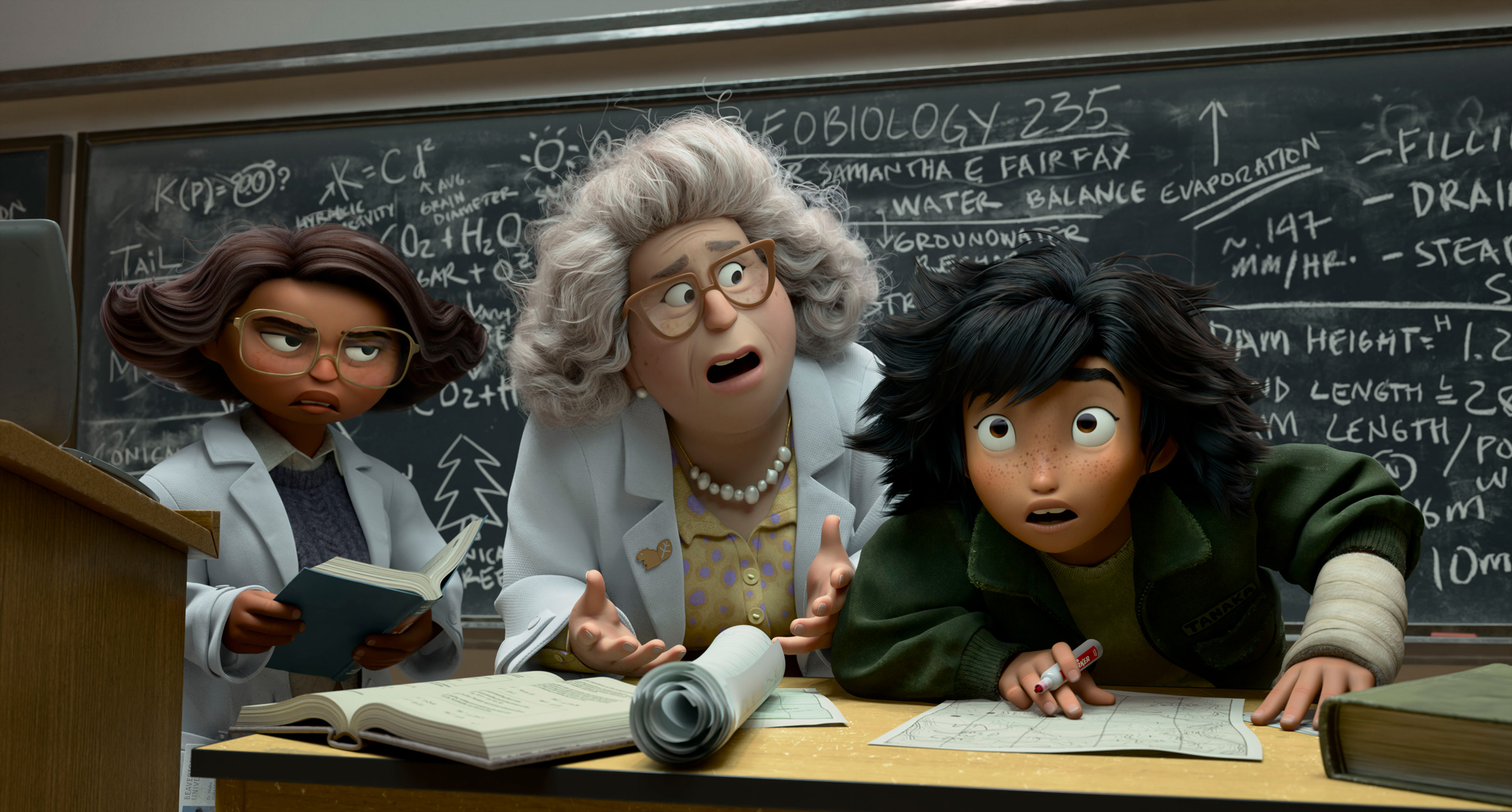
That's the premise behind Disney and Pixar's all-new feature film Hoppers, in theaters March 6. In the animated comedy, directed by Daniel Chong, scientists at Beaverton University discover how to transfer human consciousness into lifelike robotic wildlife, allowing people to communicate with animals as animals. They call this process "hopping."
But, as Dr. Sam explains in the film, "This is not like Avatar!"
For the filmmakers, it was important to establish ground rules — "pond rules," rather — about the differences between animals and humans, as well as the mechanics of "hopping."
"We wanted to dig into nature and be honest about how intense it can be," screenwriter Jesse Andrews said. "Early on, we had conversations about, 'If we're going to do another animated movie about animals, how can we make it different? What territory feels relatively unexplored?' Instead of conceiving animals that are simply furry people, we tried to keep them as animalistic as possible, while still making them funny, relatable, and identifiable."
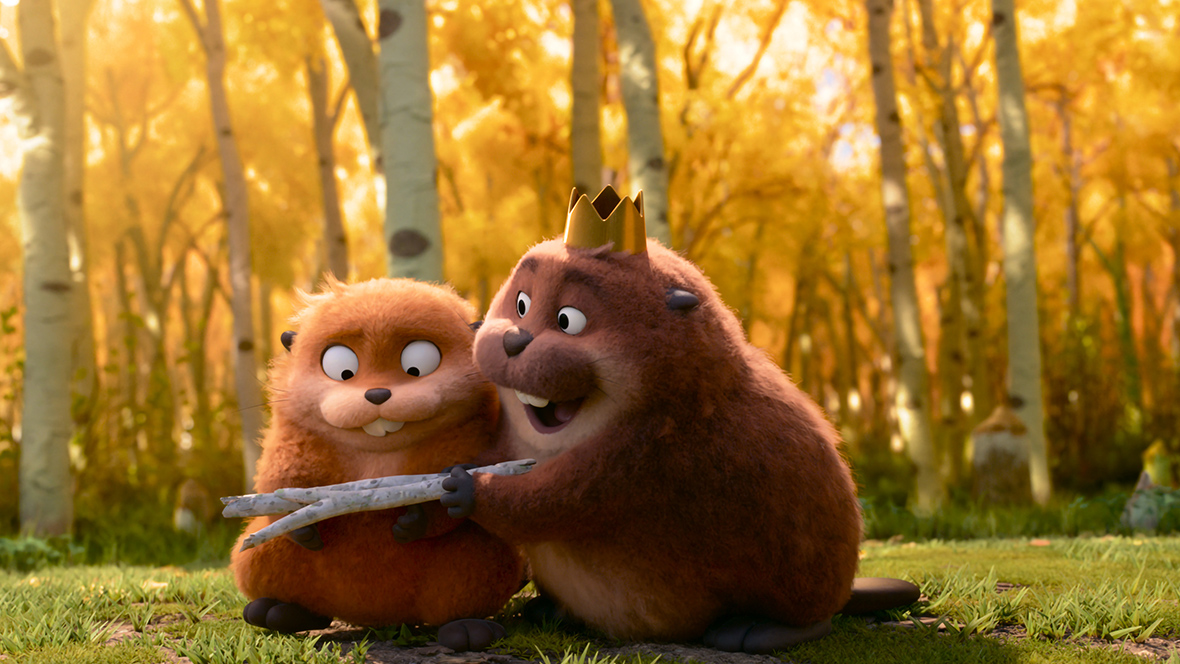
Enter Mabel Tanaka (voiced by Piper Curda), a passionate, 19-year-old animal lover who is outraged to discover that Mayor Jerry Generazzo (voiced by Jon Hamm) plans to build a new stretch of highway through the tranquil glade she frequented with her grandmother. If she can repopulate the glade with a keystone species, she can thwart Mayor Jerry's plans — but that's easier said than done. So, Mabel uses Dr. Sam's top-secret technology to "hop" her mind into the body of a robotic beaver. Now part of the animal world, Mabel befriends the jovial beaver King George (voiced by Bobby Moynihan), leader of the pond and king of the mammals, who shares three simple rules that help keep nature in balance:
- Pond Rule No. 1: "Don't be a stranger."
- Pond Rule No. 2: "When you gotta eat, eat."
- Pond Rule No. 3: "We're all in this together."
According to producer Nicole Paradis Grindle, "We didn't want [the animal characters] to feel like humans in animal suits, and that's often what storytelling with animals involves. That's where Pond Rule No. 2 comes from: 'When you gotta eat, eat.' We had to address that issue; animals do eat other animals, which makes sense when you explain it as a way of coexisting. I also love that all the animals are really benevolent. Per Pond Rule No. 1, if you know someone's name, it's hard to be mad at them. It's hard to be mad at Diane [a shark, voiced by Vanessa Bayer]. She's just doing her job. Once you know her name, she's nice. That's true of human society. If you get to know individuals, there may be some things that they have to do in order to survive that you might not agree with — but give 'em a chance."
Indeed, many of the animals — King George included — subvert Mabel's expectations, forcing her to reconsider who they are and how they interact. "King George is in charge, but he's not, like, a true king; he doesn't believe he should rule over all," Moynihan said. "He believes that everyone should be equal. He might be naïve, but he is a good beaver."
Human Nature
Mabel cares for creatures big and small, but she occasionally loses patience with people. So, while it's easy for her to empathize with the little guys... Mayor Jerry? That's a tall order, especially for a beaver. "Mabel is a spitfire," Curda said. "She wants to make the world a better place, and she's frustrated with all the things that are stopping her from doing that."
Conversely, Mayor Jerry "is a very happy guy," Hamm said. "He's very good at his job. He's well-loved by his constituents. He loves his gig. He loves family. You think, 'OK, this guy has probably got a lot of great ideas.' Unfortunately, one of them is diametrically opposed to [Mabel's]." And yet, in some ways, they're two sides of the same coin. "The arc of their journey is very similar, just from opposite directions," Hamm explained. "The good thing about that is that they both come to understand that they're part of a bigger community."
It takes a while for either of them to realize that, of course.
Early on, as a beaver, Mabel successfully rallies the leaders of various animal councils, which includes King George, Bird King (voiced by the late Isiah Whitlock Jr.), Amphibian King (voiced by Steve Purcell), Fish Queen (voiced by Ego Nwodim), Reptile Queens (voiced by Nichole Sakura), and Insect Queen (voiced by Meryl Streep). But getting them to see Mayor Jerry as a major, imminent human threat is more difficult than she predicted.
"I think her biggest surprise is their lack of outrage, because she is filled with so much rage at the injustices that have been put towards this community of animals," Curda said. "She's expecting them to also be filled with that rage, and they're just... not. They're just kind of happy to be there and making it work. I think that confuses her for a little bit, but she does end up learning from that — because rage can't be the only thing fueling your fight, you know? There's got to be something else in there. There's got to be a little compassion, there's got to be a little understanding. She definitely learns that from George, for sure."
According to director Daniel Chong, "Thematically, the movie is about questioning power. Mabel has no power. Jerry has all the power... But when Mabel hops, she enters a world where she suddenly has some power. Once she goes to the council, she gets even more power. Then the question becomes: 'Once you have that power, what do you do with it?' We combat some of the heaviness of all that through comedy. We're having fun with the absurdity of the situation, with all these wild characters who have interesting personalities."
Another major theme in Hoppers is "the importance of connection," Andrews noted.
"Because this is about nature now, in this present moment, I knew this story would also be about change," Andrews said. "Mabel is finding her way through it. It makes the movie emotionally richer."

Lush Landscapes
Just as rich as the storytelling are the settings, which required multiple departments to collaborate and develop an all-new technological pipeline. The natural world can create a lot of visual noise, so to find the right balance, the lighting and effects artists created a custom workflow that allowed them to put brushstrokes on their models. This, in turn, allowed them to simplify backgrounds without losing the rich texture of the environments.
"The natural world environment is so visually complex," visual effects (VFX) supervisor Beth Albright said. "There's so much detail — and it's beautiful — but it's a lot. If you put characters into that, and they're moving, it's hard to focus the eye. It's too much to look at."
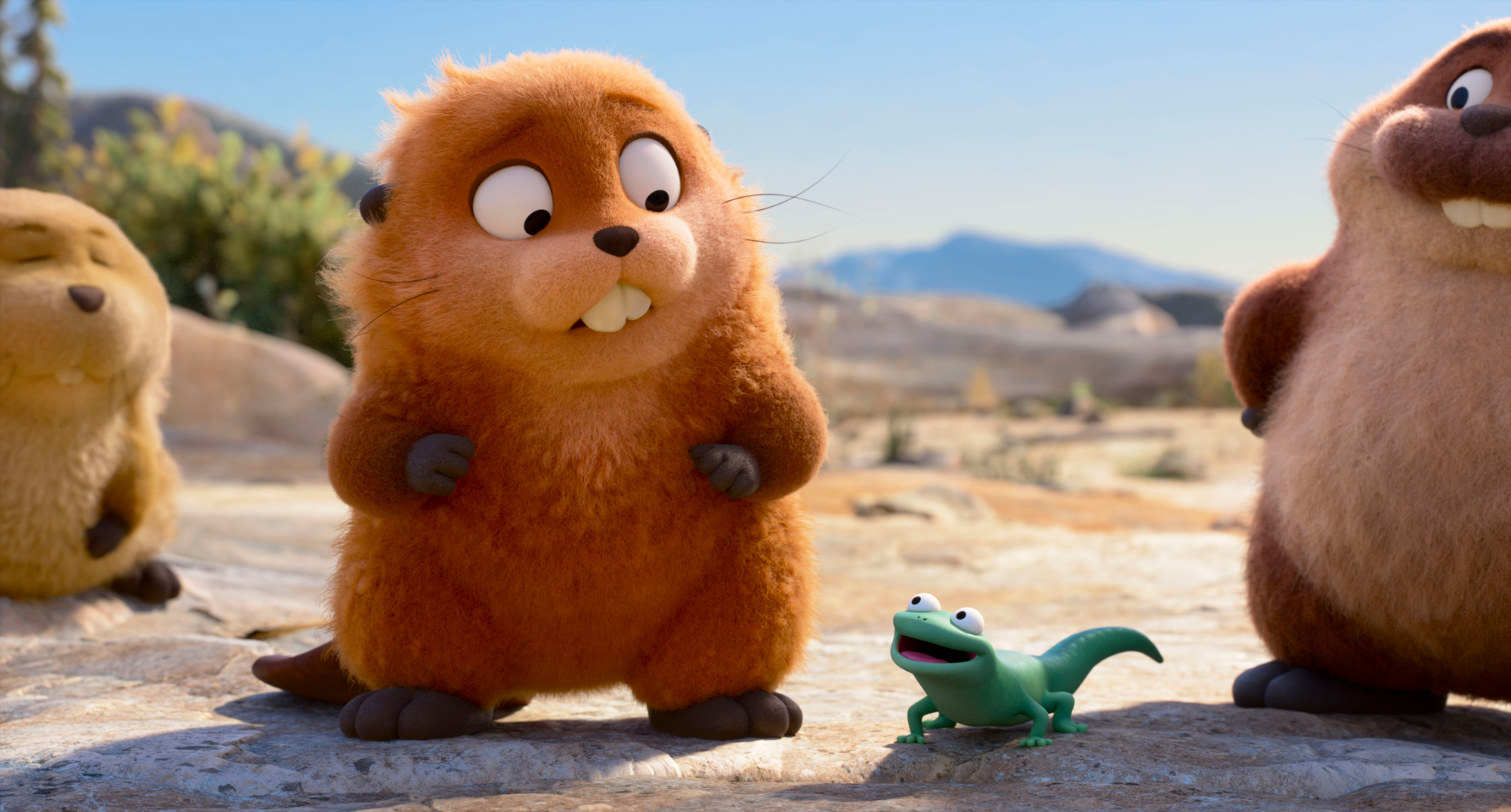
To ensure each environment had "an artistically tactile, handcrafted look," the compositing, lighting, modeling, shading, and VFX teams collaborated to create the new technological workflow. "I think the quickest way to figure out how to do something crazy is to tell someone smart that they can't do it," Albright said. "All of a sudden, things are happening!"
Once completed, they were able to take each individual leaf, turn it into a point, and then replace it with a painted brushstroke. "We're preserving all that really saturated, really vibrant color detail, and all the shading and lighting work that went into it, and then putting an artistic texture on it," Albright said. "Ultimately, that helps to 'quiet' the setting."
All that effort was worth it, according to Hamm.
"I'm really impressed with the incredible amount of artistry that went into making this, from the animation and the sound effects to the writing and directing," Hamm said. "It's a tremendous team effort. It took a long time to create this, but the proof is in the pudding."