

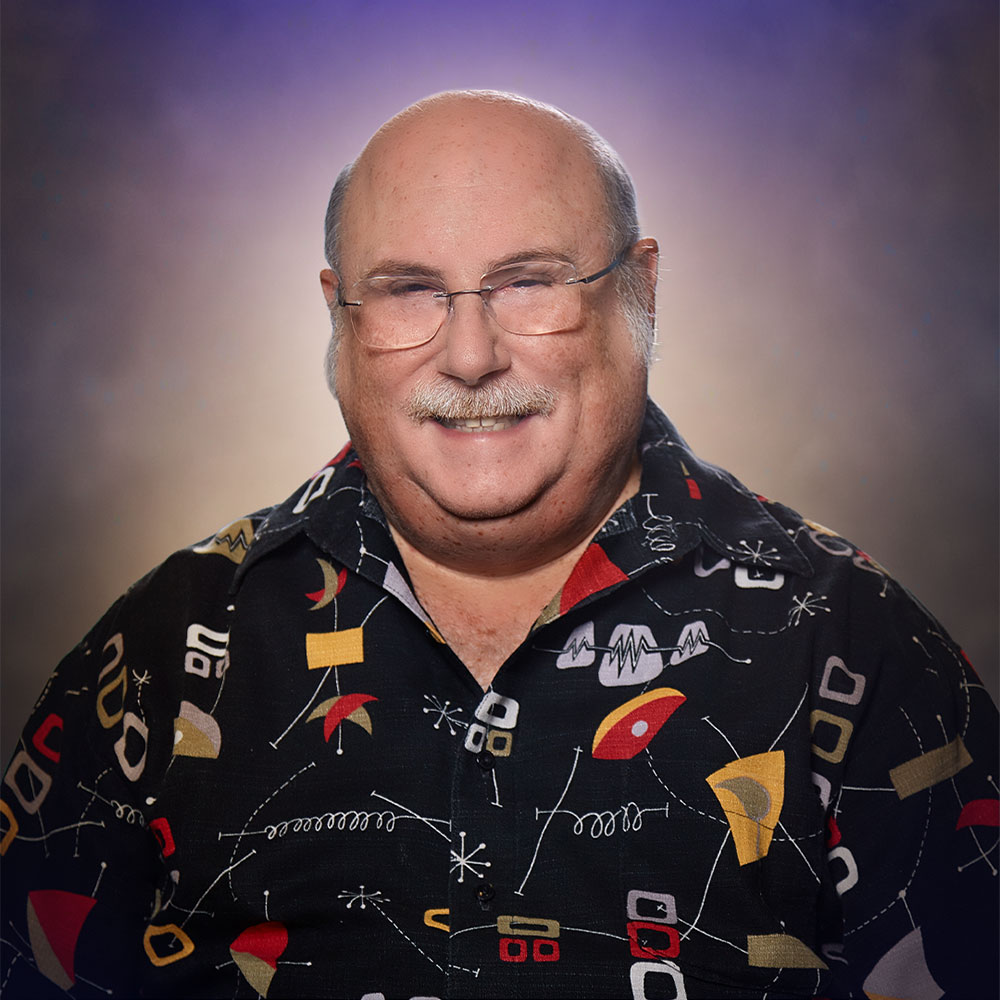
Eric Goldberg
Animation
When Disney fans wish for imaginative design, innovative action, and classically styled cartooning, they turn to the genie of Walt Disney Animation Studios—and their wishes are granted.
Acclaimed as one of the industry's top animators, designers, and directors, Eric Goldberg has brought to life some of Disney Animation's most unforgettable characters. Born in Levittown, Pennsylvania, Eric has been drawing cartoons since he was four years old. After studying illustration, filmmaking and animation at Brooklyn's Pratt Institute, he entered the animation profession in the mid-1970s, working for the famed Richard Williams animation studio. In the 1980s, Eric started his own London-based studio, Pizazz Pictures, producing animated television commercials. Then came along an opportunity from John Musker and Ron Clements, directors of Disney Animation’s then in-development Aladdin (1992). “He was the first animator on the movie, and it was a great coup for us to hire him,” Musker said at the time. “This is actually his first film for Disney. His design sense has influenced not only the Genie, but the entire film, and he is absolutely essential.”
In designing and animating Genie, Eric drew inspiration (literally) from the stylish line of famed caricaturist Al Hirschfield. Enlivened by the voice of Disney Legend Robin Wiliams, Genie is a tour de force of personality animation. Eric made Aladdin’s shape-shifting sidekick the ultimate animated character: since Genie can transform himself into any shape at any second, Eric’s quicksilver animation had him assume rapid-fire forms, everything from a bee to Jack Nicholson to Disney’s own Pinocchio. “Genie is basically a trail of smoke,” observed the animator. “As a sample of the kind of freedom we have in the forms, if I make a happy, smiling Genie, I might decide to give him very accentuated cheeks, so that we can see the expressiveness of his smile. And if I wanted to show Genie in a surprised mode, nothing would stop us… from dropping Genie’s cheeks entirely in order to go for the most direct kind of hilarious expression that we can get on the character.”
Eric next directed, with fellow Disney Animation artist Mike Gabriel, the highly stylized animated feature, Pocahontas (1995). “We wanted to present the world in a way that was kind of enchanted—so special, so delicate, so wonderful that it would be a shame if something happened to it. Which as you know, does happen in the course of the movie.” Next, Eric would serve as the supervising animator for that world-weary but wisecracking satyr, Phil, in Hercules (1997). “John and Ron have taken a canvas that's huge -- Ancient Greece and the gods -- and given it a scope and breadth that makes it magical. One thing that really does make animation magical is when it stops being something that you could see in live-action and goes to the next level. Animation allows us the scope to do things that are larger than life." As for Phil, Eric observed, “You can get a heckuva lot of bombast out of him when he boils over and gets angry. But ultimately he's got a lot of pain in him, and he’s trying to work that through. Hercules helps him deal with it.” At one point the accomplished animator drew the satyr as a literal caricature of voice artist Danny DeVito, but even as he redesigned the character, DeVito remained a strong influence, with a touch of self-caricature: “He’s short, he’s bald, he’s overweight. I can relate.”
At the turn of the millennium, Goldberg directed the “Carnival of the Animals, Finale” segment of Fantasia/2000 (2000). The synthesis of the idea originated with a question. Disney Legend and animation veteran Joe Grant asked himself: 'What happens when an ostrich encounters a yo-yo?' Eventually, Joe redrew the idea with flamingos, and Eric was tasked with taking it from there. “Joe had always imagined the piece as a tour de force for one animator,” said Tom Schumacher, then-president of Walt Disney Feature Animation. “That's why we brought the concept to Eric.” Envisioning the piece as a conflict between one individualist and six conformists moving in lockstep—that mode of marching in close file where each leg moves with the corresponding leg of the stepper just ahead—made for ample moments of humor in which Eric could breathe animated life into. For the film’s “Rhapsody in Blue” segment, also directed by Eric, he and his wife, art director Susan Goldberg, visualized a day in New York City once again in the linear style of Al Hirschfield, leading to one of the most memorable segments of the film. This veteran animator has also added his expertise to animation of the CG variety—but with a Goldberg twist. Eric supports such films as Moana (2016) and Moana 2 (2024) by overseeing the animation of Mini Maui with hand-drawn flair. “The hand-drawn and CG animators have to work together to ensure the timing between Maui and Mini Maui works,” he says, adding that wherever Mini Maui is on Maui’s body, he still needs to read like a flat tattoo. He was also the supervising animator for the lovable alligator, Louis, in 2009’s The Princess and the Frog.
Most recently, Eric oversaw the hand-drawn animation in Mickey: The Story of a Mouse, a documentary produced by Disney+, and was head of hand-drawn animation on Disney Animation’s Emmy award-winning short film, Once Upon a Studio, created to celebrate Disney’s 100th anniversary in 2023 and boasting 543 characters from more than 85 Disney Animation feature-length and short films. In 2025, Eric wrote, directed, and the led the animation for the custom episode of Hot Ones featuring Donald Duck. He is also part of a blue-ribbon team supervising the extensive film restorations of such classics as Snow White and the Seven Dwarfs (1937) and Cinderella (1950).
“Eric Goldberg was the genius behind the Genie,” reflected John Musker during the production of Hercules. “He is an animator nonpareil whose sense of entertainment and whose imagination and appeal in drawing and animation were invaluable in making a character like Phil come to life. It was always a thrill to see his latest scene unfold for the first time.”
As for Eric, all that he has accomplished with Disney Animation springs from his passion. ”I really love this medium!” he exclaims with his trademark enthusiasm. “People keep telling me, when I speak about animation, it’s infectious for them because I just have so much joy and passion for it, that I can´t contain it inside…And to think I could keep that alive, that pleasant geekery, that continues to fuel me.”